Beneficial Practices
Beneficial management practices (BMPs) provide benefits to specific crop production or environmental objectives. Within this project, the BMPs evaluated focus on the following key objectives:
Improve soil quality and health - soil quality and health are essential for agricultural productivity and ecological function. Management practices can either enhance or degrade soil health. In agricultural systems, a healthy soil sustains crop production while protecting environmental resources. In drainage management, tile drainage can support soil health by reducing erosion, compaction, and soil salinity. Understanding field specific soil conditions is critical to optimizing long term soil health benefits for desired objectives.
Improve crop productivity – crop yield and quality are central to producer viability and long-term operational sustainability. Some practices may boost short-term production but undermine long-term productivity. Beneficial practices for crop production should provide for improved productivity while building resilience against uncontrollable factors, such as extreme weather events and variable field conditions.
Reduce water runoff (conserve water) - a core principle of water management is to drain only what is necessary to improve trafficability, crop growth, and other production factors. In many cases, retaining water can be both feasible and desirable when using enhanced drainage systems. Water conservation can be achieved through practices that hold water within the soil profile for crop use, avoid intercepting and draining aquifers, or capture tile outflow for recycling.
Improve water quality - reducing nutrient and salt losses in runoff is a critical objective when implementing agricultural management practices, including tile drainage. Nutrients and salts can be transported through the soil and exported through tile drains to downstream surface water. In-field practices such as 4R nutrient stewardship, enhanced tile drainage design, and edge-of-field practices, such as runoff treatment, can reduce downstream impacts from nutrient and salt loss.
Balancing benefits and trade-offs
A single BMP may support one or more objectives while creating trade-offs for others. A couple of examples of trade-offs include:
-
A practice that limits soil loss and reduces phosphorus runoff may increase nitrogen losses.
-
Tillage can improve short-term crop productivity and weed control but is typically detrimental to long-term soil health.
When evaluating, selecting, and implementing BMPs, it is important to consider which objectives they support, which objectives are priorities for the operation, and the field conditions in which they will be applied. In many cases, multiple BMPs can be integrated or “stacked” to achieve desired outcomes.
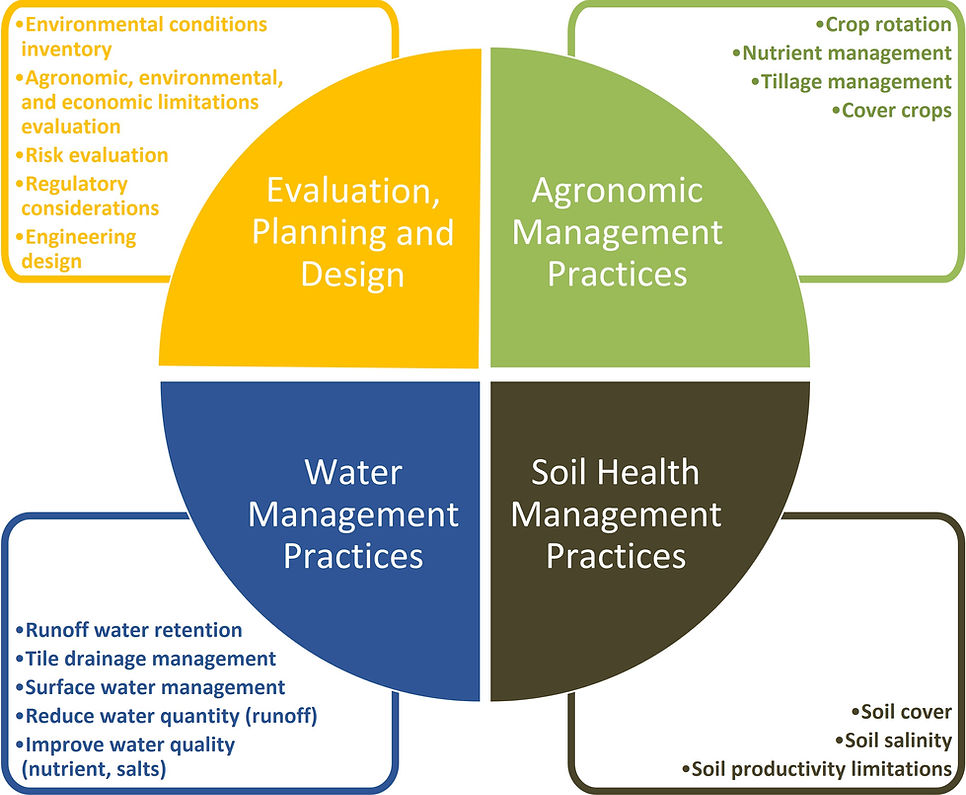
Four different BMP categories are considered in the context of this research and demonstration project. Categories and examples of individual practices are illustrated below.